Tuesday, April 23, 2013

无求无怨无忧无虑

心如止水

a simple homemade tofu,
a touch of mom's,
melts,
gratitude; 
bliss,
what could be better?

浩浩世途,是非同轨;齿牙相轧,波澜四起。公独何人,心如止水;风雨如晦,鸡鸣不已。

Thursday, March 7, 2013

Chapter 16: Thyself

little one, 
when was it that you would turn on the radio to music you like and danced freely naturally
you would arrange little chairs for guests who come to your home to listen to your stories that you read from the storybooks and wrote yourself sailing along the imaginary journey
you would sing to songs and melodies you spontaneously composed on a long car trip with the windows wind down till you fell asleep
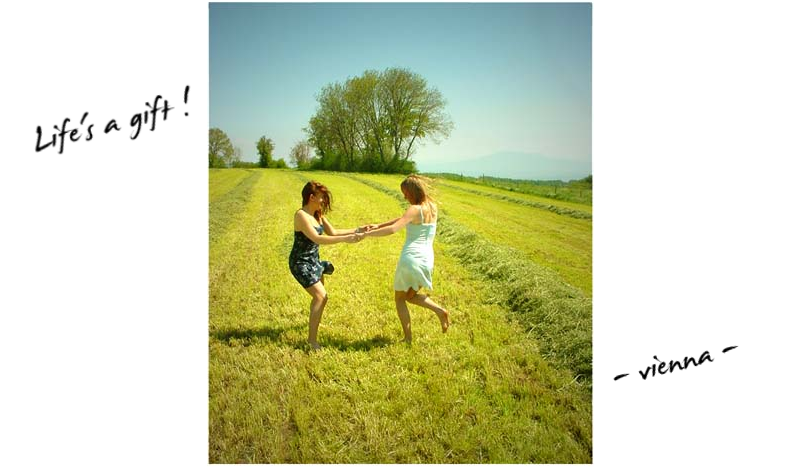
when was it that the piano violin guitar ballet shoes vienna were left in the corner;
was it dreams forgone
or dreams anew
or lens to surroundings added
is this what is to be done

some remained

little one,
dancing to whats playing in her hearts
freely
simpley. dreams.

Sunday, March 18, 2012

Friday, February 3, 2012

Chapter 15: Unlearning; ego

One cannot add tea to a cup that is already full.

Today,
I have learned to unlearn things that I have learned.
I have reflected, realized, and learned how to empty my cup;
I will embark from ground zero again, but I'd forever contemplate to keep my cup humble and open.

I realized how much it was of an arrogance on knowledge to boast my ego;
who could ever claim to have a grasp on truth?
Through experiencing actions and knowledge that are good and beneficial for many, perhaps, then, I will find it.

Thursday, January 12, 2012

Top 5 regrets people make on their deathbed.


By Bronnie Ware (who worked for years nursing the dying)

Wednesday, January 11, 2012

Chapter 14.1: Who 'in their right mind' would choose suffering by choice?


"We are dedicated to the defense of rights of individuals to free and truthful life.
In other words, our passion is liberty.
Passion translates as suffering.
And I would contend, in the political context as in the religious one, it implies suffering by choice.
A deliberate decision to grasp the cup that we would rather let pass. It is not a decision made lightly.
We do not enjoy suffering, we are not masochists.
It is because of the high value we put on the object of our passion that we are able, in spite of ourselves, to choose suffering."

I concur wholeheartedly with what she has to say; I apprehend.
I understand the backlash of passion (as with any form of attachment), and the sacrifices that needs to be made.
Still, I made a deliberate decision.

That deliberate decision started the night before Bersih - to go, or not to go.
I've watched Bersih 2007 plenty times before. I have mentally prepared myself for the worst.
I visualized that I might get kicked, punched, and beaten up badly that I might lose my limbs for the rest of my life, etc. I might get arrested, and get locked up in the jail for an indefinite period of time. I might be one of the few people (~10 people) who were there in our yellow shirt.
Going means risking my life, and my freedom.
After all that visualization, I asked myself if I would accept the worst of such consequences like death or being disabled for the rest of my life.
I answered yes. I will accept such consequences if it happens.
[No, I have never participated in a demonstration.
In fact, I was at a point of life where I was about to live the 'monastic' way - accepting that personal transformation was the only real way I could change the world, and to focus very much internally. I doubted if any demonstration will achieve anything.]
So my plan during Bersih was actually to sit down and meditate in front of the police or army forces for an hour.
I will be there - alone or not - to stand for my own values.
(Again, having laid out the 4 reasons I live my life for, years go, helps. I will try, to the best I can, to stay true to this - to stay true to myself. If I die doing what I live for, then what did I lose? (You don't lose what you don't cling to) Then, I may also well say, "My life was worth it. I lived for my values - won't cower to threats against my values/living purpose; never was a day less than 100%. I lived and leave without regrets. And, not forgetting I will smile before my last breath. What is it that you're sad for me?")

[It helps that I think about death pretty early in life. 17?]

Thursday, January 5, 2012

Chapter 14: Politics

Sometimes I think, thanks to categorization to simplify the understanding of knowledge, we are oversimplifying and misunderstanding things. (Yes, it helps our understanding to a certain extend; maybe it helps us to understand half the truth, but 50% is mediocre.)
Labeling and categorizing things makes us see knowledge and matters as discrete - science, economics, philosophy, politics, you, me, her, they, etc.

I think, the other half of the truth lies in the context, the relatives, or the interconnections.
“In the sky, there is no distinction of east and west; people create distinctions out of their own minds and then believe them to be true.”
East is only east because of west - to the west of it.

Since people often ask me why I am "involved in Politics", I will hereby explain and examine this matter.
Can we actually say "I don't care about Politics?"
Yes, you can; but that would be impossible. (Since, everything affects & is interconnected to one another. Politics, moreso.) Unless, you sincerely do not care about the hole in the roads, your Education, your safety, your life, your money (lost to corruption), your family's well being/life, or you've achieved such a Zen state that nothing can ever bug or affect you. In that case, I'll have to either pay my highest respect to you, or stop to wonder what has become of you?


  • Hey there. U r quite the activist arent u?
     ·  · November 7, 2011 at 6:20pm · 


  • Wednesday, January 4, 2012

    Chapter 13: Education


    Many people often ask me why I decided to drop out from college (not that I was failing, I was on the Dean's List of one of the World's Top 10 ranking university for International Relations undergraduates; World No. 8 for Masters and was one of the few international students - if any - awarded with a Leadership Award Scholarship). They also asked why I decided to self-study. :)
    Here's the unrefined "Why I dropped out", off the top of my head:


    Chapter 12: Beauty.

    There was a day where I saw an advertisement for Personal Image Branding & Consulting workshop in Bangsar. The workshop - which includes make up classes - boasts that attending it would boost self-confidence. I could not disagree further.
    If anything, I think that make up makes a person less confident.
    Has anyone really thought of the implicit implication to their ego and "being"? (In comparison, the implication of applying all these chemicals to our skin becomes quite minuscule 1 A blind allegiance and focus on the tangibles with a complete disregard of the intangibles breed ignorance and suffering - without one even realizing why one's suffering.)
    How can a person be more confident when they don't even love themselves for who they are - as they are?

    I beg to digress.
    I accept that I have dark eye circles, wrinkles, and I don't have flawless skin. The list goes on.
    Regardless, I will love, accept, and take good care of myself.

    "You, yourself, as much as anybody else in the entire universe, deserve your love and affection."
    “Love yourself—accept yourself—forgive yourself—and be good to yourself, because without you the rest of us are without a source of many wonderful things.”

    I interpret it as if you spend all your time drilling over your "self" how you look etc etc, and forget about giving and helping others; really, you will only devise your own demise and misery. You will never feel good that way - maybe only as long as your 'mask' is on. And, is that even a real good feeling?

    Chapter 11: People Empowerment

    So, I was recently asked by a friend for a reply on this: http://www.facebook.com/photo.php?fbid=10150451719566263&set=a.10150107120786263.278614.717236262&type=1&theater


    Malaysian, any comment on this post? (don’t attack or fighting, this is only one of the example that how people laugh at us on doing this, how can we handle and explain to them better?)
     ·  ·  · Share · about an hour ago via Mobile


    • Vienna Looi 
      If you ask me, the purpose and focus of our gathering is not even on the government, but on the people.
      We want to educate, activate, and empower the people.

      A government is only a mirror of its people. (Their attitude etc. Ie: If the people only talk and talk and talk and don't do anything, the government will also only talk and talk and talk and don't do anything. If the people don't care, the government don't care. Why should they?)

      The simple formula of change (no miracles and magic involved):

      We shan’t talk about a change in the government without a change in the people.
      But, we shan’t talk about a change in people, without first a change in ourselves.

      Start small, start now.
      A jug fills drop by drop.
      Journey of a thousand miles begins with a single step.
      34 minutes ago ·  ·  3


    Thursday, December 1, 2011

    10.1. The power of an idea.
    One very fine day, I observed that different groups were fighting to stop the Peaceful Assembly Bill. But to have any hopes at overturning this bill, we need massive pressure. So how do we achieve massive pressure? I thought of the Obama's Organizing For America campaign. Effective organization is key. We need to be way more skillful in organizing communities. Also, I realize that the general public doesn't seem to know anything. 

    In the end, we activated 14 local communities/cities all around Malaysia, from KL to Penang to Johor to Kuching to Kuantan during Christmas week. We now protest concurrently, Sat 2 to 3pm.

    Not too bad :)
    #ThePowerOfAGoodTeam
    #IAmLearningSoMuch

    10.2. Finding myself in a position where I am drawn into the game of "politics". Only that this is not a simulation - it has real life implications.
    Perhaps, I have only started to understand what politics is all about.
    When you have potentially critical information, the power, and a group of people with you, what do you do? 
    What is your strategy? What direction do you take - to lead these people to? What responsibilities do you have? How do you 'win'?

    Friday, November 18, 2011

    Disclaimer: Rereading my posts makes me laugh at my grammatical mistakes. I care about grammar - just as much as I care about everyone/everything. But I don't edit my posts (guess its pretty authentically off the top of my head?), neither do I care much about how grammar will affect one's impression of me. That's quite daft, I think. So forgive my imperfect grammar, I simply have more important things to do than to fix my grammar atm. I sincerely apologize if that causes you discomfort in anyway. Care to leave a note in the comments section of any mistakes that you found? That help would be greatly appreciated. :) I mean this. I want to learn. I want to be better.

    Friday, November 11, 2011

    Chapter 10: 14 Precepts of Engaged Buddhism


    In his book Interbeing, Nhat Hanh lays out the following 14 Precepts of Engaged Buddhism (here paraphrased), which emphasize social change as beginning with oneself.
    1. Do not be idolatrous about or bound to any doctrine, theory, or ideology, even Buddhist ones.
    2. Do not think the knowledge you presently possess is changeless, absolute truth. Avoid being narrow minded and bound to present views. Learn and practice nonattachment from views in order to be open to receive others' viewpoints.
    3. Do not force others, including children, by any means whatsoever, to adopt your views, whether by authority, threat, money, propaganda, or even education. However, through compassionate dialogue, help others renounce fanaticism and narrow-mindedness.
    4. Do not avoid suffering or close your eyes before suffering. Do not lose awareness of the existence of suffering in the life of the world. Find ways to be with those who are suffering, including personal contact, visits, images and sounds. By such means, awaken yourself and others to the reality of suffering in the world.
    5. Do not accumulate wealth while millions are hungry. Do not take as the aim of your life fame, profit, wealth, or sensual pleasure. Live simply and share time, energy, and material resources with those who are in need.
    6. Do not maintain anger or hatred. Learn to penetrate and transform them when they are still seeds in your consciousness. As soon as they arise, turn your attention to your breath in order to see and understand the nature of your hatred.
    7. Do not lose yourself in dispersion and in your surroundings. Practice mindful breathing to come back to what is happening in the present moment. Be in touch with what is wondrous, refreshing, and healing both inside and around you.
    8. Do not utter words that can create discord and cause the community to break. Make every effort to reconcile and resolve all conflicts, however small.
    9. Do not say untruthful things for the sake of personal interest or to impress people. Do not utter words that cause division and hatred. Do not spread news that you do not know to be certain. Do not criticize or condemn things of which you are not sure. Always speak truthfully and constructively. Have the courage to speak out about situations of injustice, even when doing so may threaten your own safety.
    10. Do not use the Buddhist community for personal gain or profit, or transform your community into a political party. A religious community, however, should take a clear stand against oppression and injustice and should strive to change the situation without engaging in partisan conflicts.
    11. Do not live with a vocation that is harmful to humans and nature. Do not invest in companies that deprive others of their chance to live. Select a vocation that helps realise your ideal of compassion.
    12. Do not kill. Do not let others kill. Find whatever means possible to protect life and prevent war.
    13. Possess nothing that should belong to others. Respect the property of others, but prevent others from profiting from human suffering or the suffering of other species on Earth.
    14. Do not mistreat your body. Learn to handle it with respect. Do not look on your body as only an instrument. Preserve vital energies (sexual, breath, spirit) for the realisation of the Way. (For brothers and sisters who are not monks and nuns:) Sexual expression should not take place without love and commitment. In sexual relations, be aware of future suffering that may be caused. To preserve the happiness of others, respect the rights and commitments of others. Be fully aware of the responsibility of bringing new lives into the world.

    Draft: Chapter 6 to 9.

    Chapter 6: What is Love? On the topic of romantic love, marriage, children, and what Love really is.
    Chapter 7: Detachment vs Attachment
    Chapter 8: Self-confidence
    Chapter 9: Novitiation

    I intend to write on this four subject, but before 4 comprehensive posts, here's a preview draft of what I want to say. (If I don't push myself with some drafts, who knows when I'll find time to pluck these out from my thoughts)

    Chapter 6: What is Love? On the topic of romantic love, marriage, children, and what Love really is.

    Preview:
    Apparent reality: I love you.
    Actual reality: I love you so that you could satisfy me, excite me, pleasure me, and make me happy.
                          I love myself.

    If asked for the definition of love, I would have said, "Love is the unconditional compassion that expects nothing, and knows no bounds.

    It's unfortunate that many of us do not realise nor do we analyse deep enough on how common society has convoluted, misled and deceitfully use Love for self serving purpose - which is fine.
    But if what you really meant was I love you because you can satisfy and pleasure me. Admit to it. It doesn't absolve you of self-centeredness, but at least you were honest.
    So the score is: Self-centeredness -1 Realization +1 Honesty +1.
    Don't sugar coat it to become the pure and sacred I Love You and hold yourself up high for your ability to "Love".
    Do rethink the next time you use the word "I Love You."

    I love children (wait till you see me in captain wildchild mood with my cousin -  love it! I can spend a whole day playing with him), but...?
    But just as how it pains us when one's harmed, if we look at it holistically, how can one be sure that the newly born one will bring more benefit than harm in the world?
    Though my friends kindly advised that I should think less about matters or carry the world on my shoulders, I still think we ought to do some rethinking and deep thinking on the implications of our actions.

    Marriage... would be great if it is a synergy (1+1= 3 to ) that augments each other efforts to achieve mutual goals in the world (maybe a more caring/collaborative society?) at greater heights. After infatuation, would you willingly sacrifice for the strings attached; are there resonating self/mutual expectations and resonating values?

    Ps: I am not a cynic of love. :)
    But, love in the pure form that I believe in would become increasingly rare if we kept lowering our bar/standard of what it entails. And that would mean the world would see less of it.
    I, for one, would not submit myself to a degradation of what Love is.

    Will continue this onto my views on marriage, children next time.

    Chapter 7: Detachment vs Attachment

    You get better in your job or whatever you do being detached than attached.

    Chapter 8: Self-confidence

    You become more confident by dissolving the ego, not building up the ego.

    ***********************************

    Convincing yourself that "I'm such a good speaker etc etc." does not work. In reality, you become more nervous because all your attention was on your"self", your ego.
    I once advised my bro that "all you have to do is to shift your attention from yourself to those you wish to help, impact, or communicate to." That is at least how it works for the painfully shy me.

    Chapter 9: Novitiation

    So I've thought of novitiation when I could contribute little to the society due to physical impediments (60s? if I do live that long). That's a good time to focus on developing myself mentally. I think what really entices me is:
    1. To be able to understand pleasures & desires - I'm somewhat up for such challenge (if we are aware of the possibilities of another game map, playing pacman or a bumblebee stuck in the same map feels very unadvancing, not pushing the boundaries; instead, let me reach for the stars & greater heights ;)). I want to challenge the common assumption that greed and self-centeredness is part of human nature. Let me be an experiment - to be the best human being possible :) Perhaps, then, I may be able to inspire others.

    2. To be able to explore to the depths of my mind & explore the nature of all things.
    Let me go back, to delve into the depth and nature of my mind, of all things; thereby, the universe. :D

    3. To be able to do that with unwavering focus.
    Unfortunate is the many stereotype of monastics (bhikkhu - buddh'ist' monks - literally mean beggars in Pali). The idea is for the 'beggars' to provide advice and support for the community who support them with meals in return. So there is a minimalistic but mutually beneficial way of living. I will have real time to have fun with my mind... and experience the hardships in mastering it. At least, 'I' will then be the master, instead of the slave, of my mind. (What's ironic is -- what am I referring to as 'I' here? Hah, I hope to find that out too!)

    4. To be able to challenge myself to uphold good discipline/training.

    5. To be able to give back to the community. Bhikkhus are really required to beg from the community that they're serving, in return provide help, advice, guidance, service to the community.
    6. All the problems in society (made up by individuals), are only collective manifestation of individuals problems/greed, selfishness, lack of compassion & wisdom towards others. Can these really be solved without every individual turning on a critical eye on every of their body, speech, action (which stems from your mind)? Without a foundation, one will be drown in face of all these adversities in society. If a foundation needs to be build, what's the best way to do it? Socially Engaged Buddhism (ala Thich Nhat Hanh Zen style)? Monastic style (ala Theravadian)? Humanistic Buddhism (ala Tzu Chi)?

    That is what I am exploring.

    For this, I've came up with a plan: 10 days novitiate programme starting Nov 25. To experiment and advance these intellectual discourse/preconceived ideals I've had about novitiation when I'm 50-60s to actual experience that'll bestow insights.
    To or not to?


    ************************

    I couldn't even agree with calling myself a Buddhist.
    The term perhaps implies a religion with dogmas; or I am supposed to be 'follower' to something with unquestioning faith. If so, calling yourself a Buddhist makes you less of one. I am reinforcing forms when I don't believe in them: http://www.mindfulnessbell.org/wp/2012/12/dharma-talk-the-buddhist-understanding-of-reality/ Unfortunately, someone devised the distinction between relative reality and ultimate reality to facilitate understanding.
      
         Zen sayings, "if you meet the Buddha on the road, kill him".

    No one needs that label - Buddhist, Buddhism (we already stress too much on forms; http://en.wikipedia.org/wiki/Theory_of_Forms). Buddhism certainly does not; it does not even need to be accredited. For who should - things like truth, gravity, and the like - be accredited to?

    Let go off your insecurities or wants for comforting communities. There's no need to defend truth for if there is truth, like gravity, it will defend itself.

    N/B:
    - I've been using the term truth arbitrarily: http://www.mindfulnessbell.org/wp/2012/12/dharma-talk-the-buddhist-understanding-of-reality/


    - Buddha: maybe more of a principle than the common understanding of a title conferred to Siddhārtha Gautama (one of many enlightened ones or buddhas) due to his ability to teach/influence. At the end of the day, what he taught cannot be said to be his exclusive teachings or realizations.


          In a circle, there's no starting or ending point. All ends and begins at the same time.

    Thursday, November 3, 2011

    3rd of Nov,
    Was trying hard to figure out how to use the Astro control & switch on the tv while I lunched.
    Death stared the Astro control box.
    Sister casually grabbed the control & with her magic push, Tv got turned on.

    My intention: watch some news @Astro Awani. (If no news, switch to Discovery, NatGeo, History Channel).

    Sunday, October 9, 2011


    I wanted to, I still want to comfort those kids in the slums of Rio De Janeiro, the kids in war-torn Somalia or Myanmar, I want to hug them in my arms & tell them that "it's gonna be all right."
    To that, let me just start step-by-step, I know I will get there one day. Even if I die before "ceasing tears & suffering" I know that I was 1 step closer to my goal.
    (Reminds myself of my GTD 30,000 ft goal & to pen and strategize everything down. here's to a step-by-step grand plan.)


    In the 1990s, Pastor James Wuye and Imam Muhammad Ashafa led opposing, armed militias, dedicated to defending their respective communities as violence broke out in Kaduna, northern Nigeria. Now the two men are co-directors of the Muslim-Christian Interfaith Mediation Centre in their city, leading task-forces to resolve conflicts across Nigeria. The film tells how they made this remarkable transition. It is both a moving story of forgiveness and a case-study of a successful grass-roots initiative to rebuild communities torn apart by conflict.

    If Nigerians can (from war>understanding), Malaysians can bridge our divide & lack of understanding too. :)

    All that's needed is really not a conversion from a faith to another faith, as Mr. Goenka (a teacher of meditation) said, "they can continue to remain hindu, muslim, christian, etc.. conversion should be from the impurity of the mind to the purity of the mind."


    Which reminds myself that I'm gonna meditate now :)


    What are the various reasons that make Muslim women in Malaysia wear the hijab? What are their challenges? AKU SIAPA explores these questions and more.

    Through a series of candid interviews with Muslim women, young and old, urban and rural, director Norhayati Kaprawi uncovers why Muslim women wear the hijab, and why some take it off. The interviews also demonstrate what Muslim women understand about the hijab and the Quranic verses that compel them to cover up.

    Just as importantly, AKU SIAPA interviews religious scholars, academics and politicians from both Malaysia and Indonesia about the phenomenon of the hijab and its development within Islam and in Malaysia. AKU SIAPA is a necessary viewing for those who are curious about the hijab and those who want to better understand political Islam and its impact on women in contemporary Malaysia.


    This documentary does not advocate for or against the hijab/tudung, but merely seeks to impart a better understanding "as it is" :)

    More independent films: http://freedomfilmfest.komas.org/fff/category/freedomfilmfest/schedule


    FreedomFilmfest2011 Trailer from Pusat KOMAS on Vimeo.


    This made me teary :') Orphaned at 3, alone since 5, slept on the stairs & public toilets for 10 years..yet...